Every parent knows the moment when a child groans at the word homework and then spends an hour happily absorbed in a game. That contrast holds a useful lesson. Play is not the opposite of learning, it is one of its most powerful tools. This article looks at how simple games can help children build language skills, curiosity and confidence at home or in the classroom, and how to choose activities that stay fun while still teaching something real.
Why play is the best classroom
Children learn fastest when they do not feel like they are being taught. A game gives a child a goal, a small challenge and instant feedback, which is exactly what a young brain needs to build lasting memories. When a seven year old counts coins in a shop game or matches picture cards in another language, the lesson sticks because it was wrapped in fun. Parents and teachers who understand this stop fighting for attention and start designing moments where curiosity does the work for them.
Games that introduce a second language
Language learning suits play better than almost any other subject. Simple card games, bingo boards and treasure hunts let children hear and repeat new words without pressure. Start with everyday vocabulary such as colors, animals and food, then move to short phrases like greetings and requests. Families who want their children to hear authentic grammar and tone can look at French translation services to see how professionals handle meaning across languages. Even a few minutes a day adds up over a school year, and children often surprise adults with how much they remember.
Playful practice works for adults too, not only for children. A family that enjoys language learning together can keep the habit going with short games at home. Small daily wins soon build lasting confidence.
Screen time that actually teaches
Not every app deserves a place on the tablet, but the best ones can be genuinely useful. Look for games that adapt to a child level, give gentle corrections and avoid constant rewards that distract from the lesson. Watching cartoons in another language can also help, as long as the subtitles are accurate. Poor captions confuse young viewers, and the article on subtitle translation mistakes shows how easily meaning can slip. Sit beside your child for the first few sessions, ask questions about what they see and keep the total time reasonable.
Building a routine children enjoy
Consistency matters more than length. A fifteen minute game after dinner works better than a two hour marathon on Sunday. Choose one regular slot, let the child pick the activity from a short list and keep a simple chart that shows progress. The most effective learning habit for children is a short, happy session that they look forward to every day. Celebrate effort rather than perfect answers, and avoid comparing siblings or classmates. When a child feels safe to make mistakes, curiosity grows and confidence follows.
Learning games work for children because they hide repetition inside play, so new words are practised dozens of times without anyone noticing the effort. Adults can borrow more of that approach than they usually do. Many of the most practical language learning tips follow the same principle, from labelling objects around the house to short daily challenges and songs, and they turn study into a habit that survives busy weeks instead of something postponed until there is time.
Games for the whole family
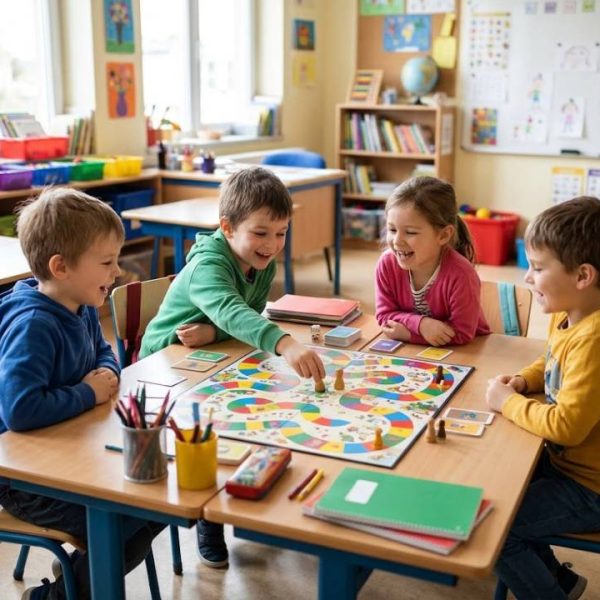
Learning is stronger when adults join in. Board games teach patience and math, word puzzles stretch vocabulary and cooperative challenges show children how to solve problems with others. Rotate who chooses the game so everyone feels heard. Grandparents can share traditional games from their own childhood, which adds a cultural layer that no app can copy. Guidance from groups such as the parenting resources from UNICEF often suggests that shared activities support emotional growth just as much as school results.
Choosing safe and age fit content
Before you hand over any game, check the age rating, the advertising and the privacy settings. Free titles sometimes show adverts that are not suitable for young players, and some collect more data than parents expect. Read reviews from other families, try the game yourself first and set up parental controls on every device. Offline games are a simple alternative, since a deck of cards or a set of building blocks needs no account and no connection at all.
Tracking progress without pressure
Parents often want proof that a game is working, but tests can spoil the fun. Instead, watch for small signs such as a child using a new word at breakfast, explaining the rules to a friend or asking to play again. Keep a notebook of these moments and share them with teachers at the next meeting. Over a few months the pattern becomes clear, and you can adjust the games to match what your child enjoys and where they still need support.
Making space for creativity
Games should leave room for imagination. Give children paper, crayons and simple props so they can invent their own rules or create a new ending. Creative play builds problem solving skills and helps them express ideas they may not yet have words for. Ask open questions such as what would happen if the rules changed, and listen carefully to the answers. These conversations often reveal how a child thinks, and they make the next game even more engaging for everyone.
Keeping the habit alive in holidays
School breaks can erase weeks of progress if learning stops completely. Keep a few favorite games in the travel bag, play word games in the car and turn museum visits into scavenger hunts. Short and playful practice keeps skills fresh without feeling like homework. Children return to class rested, confident and ready to build on what they learned, which makes the new term far easier for them and for their teachers.